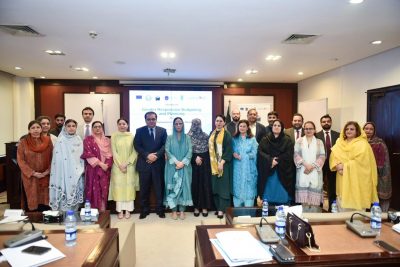
The Pakistan Institute for Parliamentary Services (PIPS) in collaboration with the Women Parliamentary Caucus, UN Women, and the United Nations Development Programme, conducted a capacity-building workshop on Gender-Responsive Budgeting and Planning (GRBP) at its premises in Islamabad, attended by 7 women parliamentarians. The workshop was designed to strengthen participants’ understanding of integrating gender considerations into fiscal planning and budget analysis, enabling more inclusive and equitable policy outcomes through informed parliamentary engagement with public financial management processes.
The initiative focused on enhancing practical competencies in assessing budgetary frameworks through a gender-responsive lens and supporting evidence-based legislative oversight of public resource allocation.
The programme commenced with the recitation of the Holy Quran, followed by an introductory programme overview by Syed Zain Gillani, Director General (PDP&C), PIPS, who outlined the purpose and expected impact of the training in strengthening parliamentary capacity for gender-responsive governance.
In his opening remarks, Mr. Asim Khan Goraya, Executive Director, PIPS, highlighted the importance of embedding gender considerations within budgeting systems to promote fairness, inclusion, and improved development outcomes. He stated that global research consistently shows that increasing women’s participation in the economy contributes directly to productivity, poverty reduction, and national growth.
Ms. Fahmida Iqbal Khan, Deputy Country Representative, UN Women, emphasized gender-responsive budgeting as a strategic approach to advancing equality and ensuring that public financial decisions reflect diverse societal needs. She recommended that atleast 15-20 percent budget must be gender responsive.
Hon. Dr. Shahida Rehmani, Secretary, Women Parliamentary Caucus (WPC), underscored the critical role of women parliamentarians in advocating for equitable fiscal policies and strengthening oversight of budgetary processes. She specifically quoted that most of the Assembly Business is carried out by women parliamentarians.
A technical session on “Gender Analysis of Previous Federal Budget” was conducted by Ms. Rashida Dohad, Specialist in Gender-Responsive Budgeting, where participants examined real budget data to identify disparities and opportunities for improved gender responsiveness in resource allocation. She emphasized women empowerment and outreach to the most vulnerable community. Dr. Sharmila Faruqui, Honourable Member, stated that the initiative should have been taken at least six months earlier, as the budget had already been developed. Moreover, she criticized the lack of interest shown by women parliamentarians, calling it disappointing to see. She appreciated Pakistan Institute for Parliamentary Services (PIPS) for the initiative and for reaching out to invite participants to this important session.
The workshop forms part of PIPS’ broader efforts to enhance parliamentary capacity in gender-responsive governance and to promote more inclusive, transparent, and evidence-driven budgeting practices.