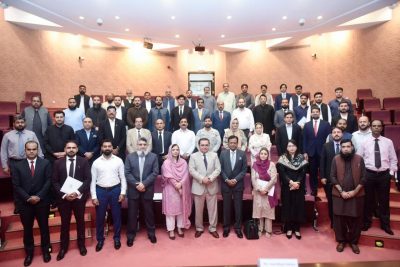
The Pakistan Institute for Parliamentary Services (PIPS) organized a Two-Day Training on “Parliamentary Procedures: The Powers and Functions of Committees and Responding to Parliamentary Questions” from 2nd & 3rd September 2026 at the PIPS, Islamabad, for Government Officers (BPS 17–19). The programme was attended by more than 50 Officers from various Ministries, Divisions and their attached departments. The training aimed at strengthening participants’ understanding of parliamentary rules of procedures, committee functions, oversight mechanisms and the effective handling of parliamentary business.
The proceedings commenced with the recitation of the Holy Quran, followed by welcome remarks by Mr. Asim Khan Goraya, Executive Director, PIPS. Addressing the participants, the Executive Director underscored the close and continuing relationship between Parliament and the Executive and highlighted the important role of Government officers in facilitating this relationship through provision of accurate information, professional support and effective communication of institutional positions before Parliament. He further observed that constructive parliamentary scrutiny contributes to improved governance, institutional performance and responsible utilization of public resources.
Setting the substantive context for the training, Mr. Muhammad Anwar, former Secretary, Senate Secretariat and former Executive Director, PIPS, led the opening technical session on “An Introduction to the Rules of Procedure.” He familiarized participants with the procedural framework governing parliamentary business and highlighted its practical significance for Government officers responsible for facilitating and coordinating matters relating to Parliament and its proceedings.
Advancing the discussion from parliamentary procedure to the committee system, Ms. Naveen Erum, Additional Draftsman, National Assembly Secretariat, delivered a session on “An Overview of the Powers and Functions of the Committees.” She elaborated upon the constitutional and legal foundations of the National Assembly committee system, various categories of committees and their legislative, oversight and administrative functions. The session also highlighted committees’ role in scrutinizing legislation and overseeing the Executive, including their authority to summon witnesses and call for relevant records.
Complementing the discussion with a practical dimension of parliamentary accountability, Mr. Talha Haroon, Deputy Director, National Assembly Secretariat, facilitated the session on “How to Respond to Parliamentary Questions: Do’s and Don’ts.” The session focused on key considerations for Government officers while preparing and processing responses to parliamentary questions, with particular emphasis on adopting an appropriate and well-prepared approach to parliamentary queries.
The second day commenced with an extensive session on “Parliamentary Oversight Tools,” conducted by Mr. Muhammad Anwar. He discussed Questions, Calling Attention Notices, Adjournment Motions, Motions, Resolutions, Committees, Privilege Motions and Points of Order, providing participants with a broader understanding of the principal instruments through which parliamentary business is conducted and matters of public importance are brought before Parliament.
Bringing the technical proceedings to a practical and application-oriented conclusion, Mr. Haris Rehman, Joint Secretary, Senate Secretariat, conducted the session on “Preparing for Appearance Before Committee Meetings.” He emphasized the importance of thorough preparation, understanding the composition and mandate of the committee, and presenting information in a clear, factual, respectful and non-partisan manner. The session further underscored the need to maintain parliamentary decorum, respond calmly to difficult questions and refrain from providing unverified facts or figures.
The two-day programme concluded with a Vote of Thanks by Director General (CB&D) Ms. Samer Awais, acknowledging the valuable contributions of the distinguished resource persons and the active engagement of the participants. The training provided a focused platform for enhancing Government officers’ practical understanding of parliamentary procedures, strengthening their capacity to respond effectively to parliamentary business and fostering informed and professional engagement between Parliament and the Executive.