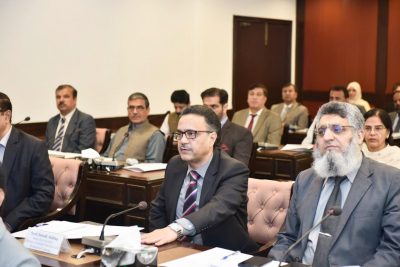
The Pakistan Institute for Parliamentary Services (PIPS) organised a two-day Orientation programme on Parliamentary Business from April 14–15, 2026, at its premises in Islamabad. The training designed for Senior Government Officers serving at the Joint Secretaries level and above in the Federal Secretariat was attended by 40 participants who were serving as focal persons of their respective Ministries and Divisions to appear in the parliament and parliamentary committees.
The primary objective of the orientation was to enhance participants’ understanding of parliamentary procedures, legislative processes, and oversight mechanisms, thereby strengthening the interface between the Executive and the Legislature and improving the overall quality of governance.
The programme commenced with the recitation of the Holy Quran, followed by the National Anthem and a round of introductions providing an opportunity for the participants to share their professional backgrounds and institutional affiliations, fostering a collaborative learning environment. The session then proceeded with the welcome remarks by Mr. Asim Khan Goraya, Executive Director, PIPS, who warmly welcomed the participants and emphasized the significance of such learning initiatives for the government officers. He highlighted that the training was conceived as a result of deliberations at the level of the Secretaries’ Committee, reflecting a collective recognition of the need to strengthen coordination between the Executive and the Legislature.
He underscored that in a constitutional democracy, governance did not operate in isolation; as the Executive and Legislature were interdependent institutions, and civil servants played a pivotal role as a bridge between them. He stressed that a sound understanding of parliamentary practices could enable officers to engage with clarity, confidence, and precision, thereby reducing institutional friction and enhancing governance outcomes. Drawing on international examples such as the United Kingdom and the United States, he highlighted that structured parliamentary training for civil servants was a global best practice. He concluded by encouraging participants to actively engage in the sessions and make the most of the learning opportunity.
The first session on Day one, facilitated by Mr. Muhammad Anwar, former secretary of the Senate of Pakistan, focused on an introduction to the Parliament’s Rules of Procedure. The session highlighted the significance of rules in ensuring the smooth functioning of parliamentary proceedings and maintaining order and discipline within the House. Mr. Anwar elaborated on the role of the Business Advisory Committee in organising and scheduling parliamentary business, as well as the authority of the Presiding Officer, including the powers of the Speaker and the Chairman in issuing rulings and maintaining decorum. The discussion provided participants with a clear understanding of how procedural rules shaped legislative processes and decision-making within Parliament.
The second session of the first day, conducted by Ms. Iffat Mustafa, Director General (Coordination/Research), Senate Secretariat, focused on the ‘dos and don’ts of appearing in Parliamentary committee meetings’. The session focused on maintaining professionalism, adhering to parliamentary etiquette, and presenting accurate and concise information during committee proceedings. Emphasis was placed on preparation, clarity in communication, and avoiding procedural errors that could undermine the credibility of the ministry. The session equipped participants with the skills required to represent their respective organisations effectively before parliamentary forums.
On the Second day, the first session was facilitated by Sheikh Sarfaraz Ahmed, (Legislative Advisor), Ministry of Railways, who provided a comprehensive overview of the legislative process, from the initiation of a bill or legislative proposal to its enactment as law within the framework of the Constitution and the Rules of Business, 1973. He explained key stages, including drafting, introduction of the official and private member bills, committee review, consideration of both Houses, and presidential assent, while also clarifying distinctions between principal and delegated legislation. The session also examined the constitutional and procedural dimensions of ordinances. Drawing on practical case studies, the facilitator highlighted the role of the Executive in initiating legislative proposals and formulating subordinate legislation, alongside emphasizing the importance of coordination between ministries and the Parliament throughout the legislative process. This session enabled participants to develop a clear understanding of how policies were translated into enforceable laws.
The final session, facilitated by Syed Hassan Raza Gillani, Deputy Secretary (Legislation), National Assembly Secretariat, focused on the use of oversight tools and committees for effective governance. The session highlighted the critical role of parliamentary committees in ensuring accountability and transparency within the government, and the use of various oversight tools, including questions, committee reviews, and other parliamentary instruments, to oversee executive performance. The facilitator emphasised the importance of timely and well-prepared responses by ministries and provided practical guidance on effectively engaging with oversight mechanisms. The program concluded with a vote of thanks by Ms. Samer Awais, Director General (CB & D), PIPS, who expressed her sincere appreciation to all participants for their active involvement and engagement throughout the two-day orientation. She extended her gratitude to the distinguished facilitators for sharing their knowledge and expertise.