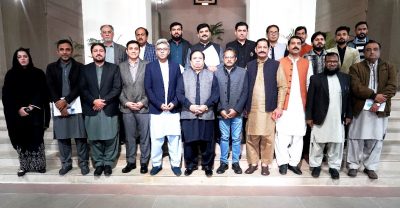
The Pakistan Institute for Parliamentary Services (PIPS) is conducting a three-day in-house training on Artificial Intelligence (AI) for the reporters of the Punjab Assembly Secretariat. A total of 17 reporters are participating in the programme, which is designed to build practical skills for applying AI tools to enhance efficiency, innovation, and digital transformation within public administration.
The training seeks to deepen participants’ understanding of AI and its effective use in government functions, with a particular focus on ChatGPT, Gemini, Copilot, and other generative AI tools. The programme aims to strengthen reporting, research communication, committee coordination, and workflow management while encouraging the adoption of modern digital solutions in line with contemporary governance standards.
The inaugural session began with the Recitation of the Holy Quran. Mr. Shahab Khattak, Assistant Director, moderated the session and warmly welcomed all participants on behalf of the Executive Director, PIPS. He provided a brief overview of the programme and acknowledged the participants’ dedication to acquiring new skills and knowledge in Artificial Intelligence to support the functions of the Punjab Assembly Secretariat.
Mr. Asif Zamir, Director (Information Technology), PIPS, opened the technical segment with engaging questions on Artificial Intelligence (AI), Machine Learning (ML), Deep Learning (DL), and ChatGPT, fostering an interactive and thought-provoking learning environment. He elaborated on how ChatGPT operates—through prompts, tokens, and responses—discussed various types of AI, including Narrow AI, Artificial General Intelligence (Generative AI), and Super AI, and introduced key concepts such as Natural Language Processing (NLP) and Large Language Models (LLMs). The session also covered ethical considerations, responsible AI use in government, and elements of Pakistan’s National AI Policy.
The second day was focused on enhancing reporters’ skills in drafting news briefs, summaries, and parliamentary updates using Gemini. Participants practiced simplifying complex legislative content into clear Urdu and English. They used Gemini for rapid background research and generating committee-related reporting notes. Practical exercises included producing policy briefs and proceeding summaries. The session ended with guidance on verifying AI-generated information for accuracy.
On day three the reporters were given the insight in drafting press releases, talking points, and parliamentary news scripts using Microsoft Copilot. Officers learned to create public-friendly summaries, FAQs, and social media posts to enhance citizen outreach. Copilot’s integration with Word and Teams was used for generating notes and organizing reporting workflows. Participants prepared a sample reporting assignment through Copilot. The day concluded with group presentations and feedback.
Mr. Shahab Khan, Assistant Director PIPS commended reporters for their active participation and adaptability in using AI tools. He highlighted that Gemini and Copilot will significantly improve the speed, clarity, and quality of parliamentary reporting. He encouraged participants to apply these tools in daily coverage to enhance transparency and public awareness. He reaffirmed PIPS’ commitment to ongoing capacity building. The session concluded with appreciation for facilitators and the Secretariat’s cooperation.