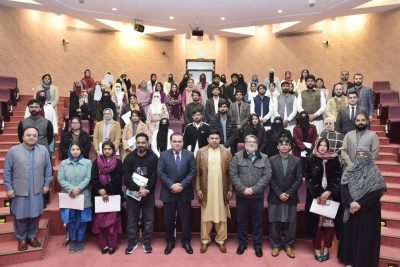
The Pakistan Institute for Parliamentary Services (PIPS) conducted a day-long Seminar on Working of Parliament, Legislative Process & Parliamentary Committees on Dec 4th, 09:30 am to 03:30 pm. It was arranged for a group of 50 students from department of Social Sciences, University of Gujrat. The purpose of the visit was to make the students understand the salient features of the Constitution, the working of the Parliament, Committee effectiveness and legislative process. Mr. Tanzil Ur Rahman, Assistant Director (Research) moderated this interactive session. The proceedings started with the National Anthem followed by recitation of verses from the Holy Quran by Qari Anis ur Rehman.
Mr. Asim Khan Goraya, Executive Director, PIPS delivered welcome remarks as the session formally began. He warmly welcomed the students and faculty of the University to PIPS. He highlighted the institute’s role in strengthening democratic governance through research, learning, and informed citizenship. He emphasized that young people are the future of Pakistan and that the country’s progress depends on their knowledge, integrity, and engagement with democratic institutions. Reflecting on global changes driven by technology, climate, and geopolitics, he stressed that nations succeeded by empowering their youth and investing in intellect and innovation. He reminded the audience about Quaid-i-Azam’s belief in the potential of students, and encouraged them to think boldly, learn deeply, and act responsibly in every field they pursue. He also appreciated the efforts of the PIPS Research Wing for organizing the seminar and expressed hope that the visit would inspire students to better understand democratic processes and contribute to Pakistan’s development.
The delegation from University of Gujrat was headed by Dr. Muhammad Mushtaq, Chairman Department of Social Sciences. He formally thanked the worthy Executive Director PIPS Mr. Asim Khan Goraya and praised the role of PIPS in bridging the gap between Parliament and the students. He also thanked Mr Muhammad Rashid Mafzool Zaka DG Research and the team Research for organizing the Seminar. He acknowledged that such events provide the students great opportunities of learning and knowledge sharing.
The first session of the Seminar was on the salient features of the Constitution and Working of the Parliament, Mr. Muhammad Rashid Mafzool Zaka, Director General (Research) PIPS, explained in simplistic terms the constitution and state. He also elaborated the rights of citizens enshrined in the constitutions and the responsibilities that they owe to the state. He explained how Pakistan’s Parliament operates as a bicameral institution through the National Assembly and Senate. His presentation offered an in-depth discussion on the functioning of Parliament. Adopting an interactive approach, Mr. Zaka proactively engaged participants, encouraging questions and dialogue on matters of parliamentary working. He briefed participants on Parliament’s main responsibilities, including making laws, representing public concerns, overseeing government performance, and reviewing the national budget.
The 2nd session was on parliamentary Committees, which was held by Ms. Tehseen Khalid, Director Research PIPS. She explained the Committee system in detail; the composition, types, functions etc. She began her presentation with relevant constitutional provisions which establish the legal framework for the parliamentary committees in Pakistan. She highlighted the significance of the committee with the well-known saying that “Congress in session is Congress in exhibition while Congress in committee room is Congress at work.” Similarly, committees are often termed as the “eyes and ears” of the parliament. She highlighted the rules of procedures pertaining to committees and noted that committees are just recommendatory bodies. She also delved upon various powers and duties of the committees.
The 3rd Session was on Legislative and Non-Legislative Business, which was conducted by Mr. Abdul Nabi Solangi, Deputy Director (Legislation) PIPS. He briefed the participants about the “Legislative Process and Services.” He talked about underlying principles of legislative process in Pakistan which include; Islamic code of life, separation of powers, parliamentary democracy, bicameral legislature and independence of judiciary. He also presented the schematic illustration of the law-making process in Pakistan. Mr. Solangi also shared different types of legislative instruments such as bills, acts and ordinances. In the end, he also explained non-legislative tools in details for better understanding of the students. In an interactive Q and A session, the PIPS faculty answered to absorbing questions raised by the participants pertaining to constitutional amendments. The session concluded with PAKISTAN ZINDABAD. The event concluded with the lunch served to students at PIPS cafeteria, followed by a visit to the Parliament.