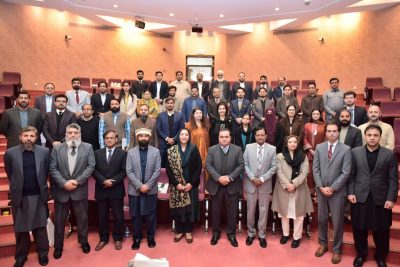
The Pakistan Institute for Parliamentary Services (PIPS) successfully organized a one-day training programme titled “An Orientation to the Powers and Functions of Committees and Parliamentary Questions” for officers from various Ministries, Divisions, and their attached departments for providing an understanding of parliamentary Committees and Questions and their role in supporting effective governance, on January 20, 2026, at the PIPS Auditorium. The program was attended by 59 participants.
The event began with the National Anthem and recitation of verses from Holy Quran by Qari Anees ur Rehman, followed by welcome remarks from Mr. Asim Khan Goraya, Executive Director, PIPS. In his address, he warmly welcomed the participants and highlighted the crucial role of government officers in strengthening the link between Parliament and the Executive. He emphasized that well-prepared, timely, and accurate responses to parliamentary committees and questions are essential for transparency, accountability, and public confidence in democratic institutions. During the event overview, Ms. Samer Awais spoke about the important role of the (CB&D) Wing in training government officers on core parliamentary business. She highlighted how understanding parliamentary processes not only strengthens governance but also directly benefits the citizens of Pakistan.
A major highlight of the workshop was the session on the Powers and Functions of Parliamentary Committees and the expectations of Members of Parliament from government officers appearing before committees. Honourable Wajeeha Qamar (MNA), Minister of State for Federal Education and Professional Training, described parliamentary committees as the heart of parliamentary oversight and stressed on the importance of thorough preparation, respectful engagement, and timely submission of information, noting that effective interaction with committees helps strengthen both policy outcomes and public trust.
This session was further enriched by Ms. Iffat Mustafa, Director General (Coordination/Research), Senate Secretariat, who shared practical insights on preparing for committee meetings and responding constructively to Members’ queries. Her guidance helped participants better understand how proactive and well-informed engagement can support effective parliamentary oversight.
The technical session that introduced the participants to the Rules of Procedure, was facilitated by Mr. Muhammad Anwar, former Executive Director, PIPS/ Secretary(R) Senate Secretariat. Drawing on his extensive experience, he explained key parliamentary rules of procedure and encouraged officers to approach parliamentary business with clarity and confidence.
In the concluding session, Mr. Muhammad Mushtaq, Advisor on Legislative Parliamentary Proceedings and Training at the National Assembly, led an interactive discussion on “How to Respond to Parliamentary Questions: Do’s and Don’ts.” He provided practical tips on drafting clear, accurate, and concise replies, emphasizing the role of parliamentary questions as a vital tool for accountability and informed decision-making.
The workshop concluded on a positive note, with participants appreciating the practical discussions and expert guidance. PIPS reaffirmed its commitment to building the capacity of government officers and strengthening cooperation between Parliament and the Executive, recognizing such initiatives as essential for a responsive and effective democratic system.